

Fielden Whisky



Fielden Whisky
In this Q&A, we talk to Chico Rosa, Fielden Whisky’s Master Distiller. Chico grew up in a Portuguese winemaking family and now leads Fielden’s innovative approach on whisky-making. From regenerative farming and heritage grains to experimenting with cask maturation, he’s helping to shape the future of distinctive English rye whiskies.
You grew up in a Portuguese winemaking family - what drew you to whisky, and how did that shape your journey in the spirits industry?
I have been ever curious about science, particularly aromas and flavour, and whisky has been my last stop on the journey. Since an early age I used to play with potions, inspired by mad scientist cartoons and books. Instead of wanting to be an astronaut or a footballer, when I was 5 years old I wanted to be a perfume scientist.
I was always fascinated by the effect of a liquid on someone’s life and being surrounded by wine I was naturally introduced to all intricacies of its culture, from the work with nature in the vineyards, the process in the cellar and the fascinating apparatus of lab analysis. As I grew up, I got on this journey to always seek more knowledge and experiences. Between working in other wineries and studying agronomy (because wine should be made in the vineyard), I discovered brewing and got mad for what potential synergies there could be between beer and wine.
I graduated in food science and engineering and my heart was split between the two, until I decided to pursue the science of working with grains over grapes, as the fruit was more familiar to me. It was in Scotland, during my master’s degree in brewing and distilling that I found the magical complexity of whisky and spirits in general. It was almost like going back to childhood when I was imagining myself creating potions and fragrances. It felt like my whole life has been the right journey, passing through different crafts, learning from mentors and now I could combine all that knowledge together in one – whisky.
What makes Fielden’s approach to whisky-making different from other English brands?
The desire to question tradition will always drive innovation. In the Fielden genesis, there is the desire to think differently and reimagine how meaningful whisky can be in its own definition. Whisky is the spirit of grain in the rawest sense.
In a world where copper and wood seems to take the attention, we tend to forget what whisky is actually made from. The majority of whisky in the world is produced from the same varieties of barley, corn, wheat or rye. Distillers tend to not know how or where these grains came from. When distillers do know, that grain is usually the same variety as everywhere else, grown in the same way but grown locally.
Fielden wanted to take a step further, looking for answers in the past, so long ago that it could be seen as innovation. In the end we wanted to give the highest meaning to whisky by working with as many grains we could put our hands on and try to grow them as nature would, if we were not here. We brought farmers on the journey with us and became a grain business as much as a whisky business.
How does regenerative farming and the use of heritage grains actually shape the character of your whiskies and are there any whiskies or projects you’re especially proud of?
One thing I learned from agronomy and food science is that a biological material is always the sum of its input combined with the processes from its genesis and time. A grain will be the result of whatever its parent grain was exposed to at a certain given time. It is easy to understand that growing anything in hydroponics with a set range of nutrients will give different results compared to growing a plant in a rich healthy soil.
Both grow well but there are so many pathways in growing that one is more complete than the other. It is a bit like humans feeding exclusively from supplements and water or having a diverse and complete healthy diet.
With grains grown in a regenerative way, we are setting the growing for success with rich healthy plants forming the grains we use for whisky. Working with diverse grains including heritage grains allow us to not only benefit from diversity and resilience in the field but also from diversity in the base of our whisky. That diversity will impact physical and chemical properties in each step of whiskymaking.
We see our spirit style being quite defined on the top notes with a wide complex range of nuances. The more you add to a pot, the more it will gain that specific tasteful character, but then we have the side notes of earthy, mineral, floral, spices and herbal elements. I’m super proud of our Fieldnotes series where I deconstruct the Fielden spirit character and take inspiration from the English countryside.
English whisky is still carving out its identity - how do you see Fielden’s whiskies shaping that story, and could your regenerative approach influence the wider industry?
The best measure for success is having others doing things as you are. Our ultimate goal with Fielden is to promote the debate, bring everyone to the conversation and, together, create more meaningful whiskies. Regenerative farming is part of giving meaning to whisky, not from a storytelling perspective, but from a sustainable and quality point of view.
England is incredible to grow cereals, it has the tradition, the perfect soil diversity and a great climate. I see Fielden promoting more distilleries to take attention to not only what grains are being used for whisky, but also how grains are grown for whiskymaking. So far all English whisky has to be made from grain grown in the UK. We could definitely take an extra step on the definition of English whisky.
Does the type of glass you use make a difference when tasting whisky?
One hundred percent! Tasting whisky is one of the most fascinating sensorial experiences of humankind. We have aromas, textures, colour and touch, all playing together with our brain. A glass can uplift or downgrade the whisky and can be so occasion specific.
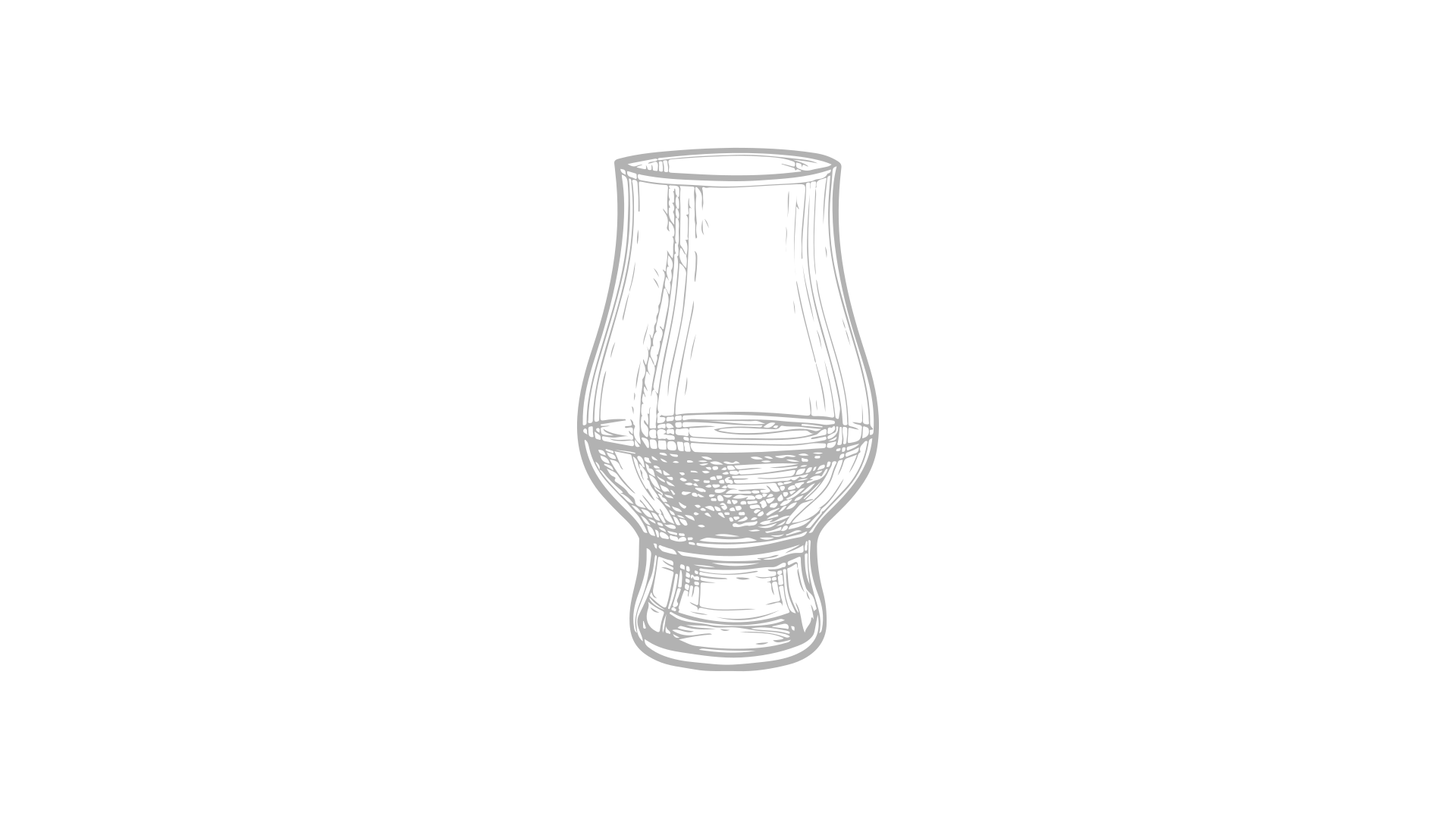
I always prefer thin rim glasses for a better touch between mouth and liquid. It also looks better. A glass with a balanced design to open up the liquid, trap and mingle volatiles while releasing the right amount of aromas through the tasting is essential for a savouring experience. The Glencairn Glass joins all these attributes in a portfolio for different occasions – I love using them!